
The first Mrithika Brindavan of Sri Raghavendra in Tamilnadu and the third in the country.
Kaveri Karai Sri Anjaneya, Sri Raghavendra Temple, Erode, T Nadu
Sri Hari Sunder
Sri Raghavendra
 Sri Raghavendra Swami, Mantralayam - courtesy: Wiki Commons. It is popular belief that Pujya Sri Raghavendra is the reincarnation of Sankukarna, Prahlada, Bahlika, and Vyasaraja tirtha in order. In his previous incarnation, Pujya Sri Raghavendra was Sri Vyasaraja, who had established 732 shrines for Lord Anjaneya and had personally worshiped Lord Venkateswara. It is no wonder that Pujya Sri Raghavendra was named Venkatanatha in this incarnation and a devotee of Lord Venkateswara.
To know more about this great saint and his life, kindly see the Brief Biography of Hanumath devotees - Pujya Sri Raghavendra Guru on our website.
Sri Raghavendra Swami Brindavan
Saints who practice dwaitha philosophy chose a sacred place of their choice to relieve themselves from this mortal coil and obtain jeevamukti. In the thus selected sacred place, a Brinda plant (Tulasi) is planted, and the place is worshiped for invoking the blessings of the Saint. Saint Sri Raghavendra chose the village of Manchale as his last place of rest.
Today the village Manchale where his brindavan is situated is known as “Mantralayam”.
Living Saint
Even after entering Brindavan about 350 years ago, he is believed to be alive to answer the call of his devotees. Since not all his devotees could travel to Mantralayam to get blessed by their guru, the practice of taking the sacred soil from his Brindavan and worshiping it as “Mrithika Brindavan” came into existence. Today we have scores of such Mrithika Brindavans in India. One of the earliest Mrithika Brindavan is located in Erode, Tamil Nadu.
Despite entering Brindavan approximately 350 years ago, he is said to be still alive, responding to the call of his devotee.
Erode
This town is located on the banks of the Kaveri River in the western part of present-day Tamil Nadu. This place has a long history, and at one stage of time, many scholars and saints of dwaitha philosophy were living in this town. More on the history of Erode and the influence of Dwaitha Saints in our web page: "Mulbagal Mutt, Nav Brindavan".
Kaveri Karai Anjaneya Temple
It is a practice of devotees to take a bath in the river of their kshetra. The Kaveri River, is flowing through Erode, is considered sacred, hence, many devotees come to the river here for taking bath. After taking a bath in the river, it is also a practice to offer a prayer to their preferred deity. Since there were many followers of Madhva philosophy here, they had a small temple for Sri Mukhyaprana [Sri Anjaneya] on the riverbank. There was a gopuram [tower] for this temple, and in front of it was a stone mandapam. There, they used to offer their prayers as their practice.
Mrithika Brindavan of Sri Raghavendra
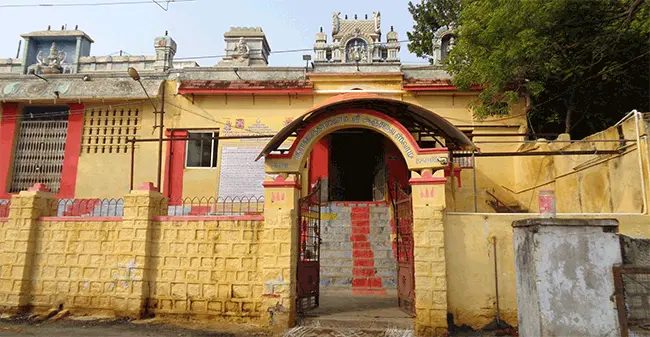
 Sri Anjaneya Temple and Sri Raghavendra Temple, Erode, TNadu. After Sri Raghavendra Theertha had entered Brindavan at Mantralaya, devotees used to go to Mantralaya to offer oblation. Even though devotees want to go to Mantralaya, not all devotees of Erode and around can afford to go to Mantralaya to offer their prayers. Therefore, after consultation with elders, it was decided to bring holy soil from Mantralaya and establish a “Mrithika Brindavan” at Erode, for the benefit of devotees from Erode and around.
The task of bringing the sacred soil with all religious fervor to Erode without deviating from the prescribed rituals was undertaken by Sri Ramachar, a Vedic scholar of Erode. It was around sixty years after Sri Raghavendra guru entered the Brindavan at Mantralaya that Sri Ramachar undertook this endeavor. The holy soil was brought from Mantralaya to Erode with the participation of devotees from the villages and towns on the way. They had provided all religious arrangements and facilitated the smooth passage of the convoy.
Thus, bringing holy soil, a small Brindavan on the banks of the Kaveri River, near Sri Mukhyaprana temple. This Mrithika Brindavan is the first to be established in Tamil Nadu and the third in the country. It had attracted many devotees of Sri Raghavendra Swami.
After taking a bath in the river, it is also a practice to offer a prayer to their preferred deity. Since there were many followers of Madhva philosophy in this kshetra, they had a small temple for Sri Mukhyaprana [Sri Anjaneya] on the Kaveri river bank. There was a gopuram [tower] for this temple, and in front of it was a stone mandapam. There, they used to offer their prayers as their practice.
Renovation and restructuring Mrithika Brindavan
Nearly two hundred years later, the need for renovating the Mirthika Brindavan was felt. An initiative to this effect was taken by Sri Mantralayam Krishnachar, who worked as a Sanskrit teacher in Erode Mahajana School. He collected donations from the devotees for this purpose. And in the year 1912, with the donations thus collected, he renovated the entire complex, and also the Mirthika Brindavan. The Brindavan was restructured with seven pedestals on the same model as found in Mantralaya. Kumbhabhishekam was performed after the renovation and restructuring.
Kumbhabhishekam then after
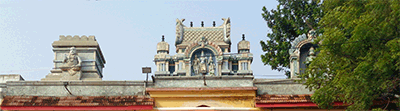
 Sri Anjaneya, Sri Raghavendra Temple, Erode, TNadu. In the year 1938, the old mandapam, which was in existence along with Sri Mukyaprana temple, was in a state of dilapidated condition. This mandapam was removed, and an entirely new hall was built in the same place. Raja Gopuram with idols of Rama, Sita, and Anjaneya was constructed in Raghavendra Temple. After all this renovation, Kumbhabhishekam was performed.
After that, the renovation and Kumbhabhishekam in the year 2009, and presently, [Jan 2024] preparations are on for the next Kumbhabhishekam.
Kaveri Karai Sri Anjaneya
Sri Mukhyaprana [Sri Anjaneya] of this kshetra is facing the Kaveri River, which is flowing to the east of the temple.
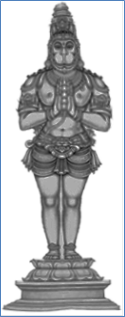
Sri Anjaneya idol sculpted as a full vigraha is placed on an inverted lotus pedestal, which is placed on a square avudaiyar.
Lord standing position, seen with His hands in Anjali posture. Lord is wearing both hollow anklet [Thandai] and chain anklet [Nupur] in His lotus feet. The ‘katcham’ style dhoti is held by an ornamental waist belt. In the folded hands, in the wrist, a hollow bracelet known as kankan is seen, and in the upper arm, a bracelet known as keyur is seen. An ornament known as ‘bhuja valaya’ covers His shoulders. In His bosom are seen two garlands. Yagyopavit with mujia is also seen across His bosom. The bright face with bubbly cheeks and long ears is bound to rivet the attention of the devotee. In the long ears, one could see the ear pendant dandling. The neatly tied kesam is ducked under the crown on His head. The tail is not visible as it is in the back and drops near His feet with a curve at the end.
Location of the temple: Kaveri karai Sri Anjaneya temple, Erode
Experience
Lord of this kshetra had guided His devotees to achieve their righteous goal of building the Mirthika Brindavan of His devotee here. Darshan and prayers in this kshetra, He is sure to guide us accomplish our goal.
OTHER INTERESTING TEMPLES
SRI HANUMAN THINKS DIFFERENTLY, THINKS FAST
THINKS AHEAD AND ACTS FOR SURE
Ed [September 2025]