
An ancient temple for Hanuman on the banks of Imphal River
Shree Mahabali Hanuman Temple, Imphal, Manipur
Sri Hari Sunder

input & images by Smt. Dr. Kausalya
Imphal
 Imphal is the capital of Manipur. The metropolitan centre of the city contains the ruins of Kangla Palace, officially known as Kangla Fort, the former royal seat of the Kingdom of Manipur, surrounded by a protective moat. The city is spread across both the districts of Imphal West and Imphal East, with Imphal West having the majority of the city's area and population. The Meitei language, officially recognized as Manipuri, is the predominant language spoken by the city's residents.
During World War II, Japanese armies invaded India and attempted to destroy the Allied forces at Imphal. But they were driven back into Burma with heavy losses. In 2013, the British National Army Museum honored this battle, known as “The Battle of Imphal” as Britain's Greatest Battle.
The name Imphal is derived from words: "Yum," meaning "house," and "Phal," meaning "plenty" or "beautiful". In the old Manipuri language, "yum" is also spelled as "im". The Imphal River flows through the city, adding to its scenic beauty.
Temples of Imphal
 Imphal is home to numerous ancient temples, all dedicated to the Vaishnava tradition. The principal deity worshipped in these ancient temples is Shree Govindajee, another name for Lord Krishna. Among these sacred sites is the Shree Shree Ramji Prabhu Mandir, dedicated to Sri Rama, and the Shri Mahabali Hanuman Temple, dedicated to Shree Hanuman. Many of these revered temples are located in and around the historic Kangla Palace.
Shree Mahabali Hanuman Temple
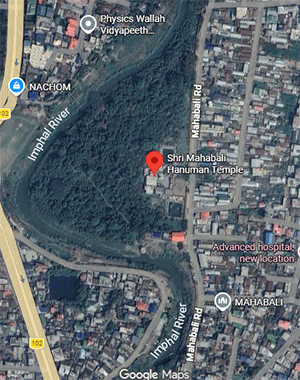
The River Imphal takes a curve near the Kangla Palace complex, forming a vast area between the River and the palace. Over time, this area has evolved into a dense forest. The temple for Shree Hanuman was built at the edge of the forest and near the Palace complex. Shree Hanuman is known by the name “Mahabali” —a term signifying great strength and immense power. The forest also acquired the name “Mahabali forest”, due to its dense vegetation and the presence of the Shree Hanuman Temple.
It was built by King Garib Niwaj in 1725 AD. The temple was built of bricks, and later a cement coating was applied to the entire structure. The temple reminds us of the spread of the Ramanandi cult of Hinduism in Manipur. It is the only temple built during the period of Garib Niwaj. Over a period, there were developments and additions to the main temple.
The exterior of the Garbhagraham features a prominent red bulbous dome, supported by golden pillars at each of the four corners. This dome is reinforced by intersecting parabolic arches and is crowned by a golden, multi-tiered Kalash. Atop the Kalash is a 'neel-chakra' flag, held aloft by a staff.
Shree Hanuman Temple Complex
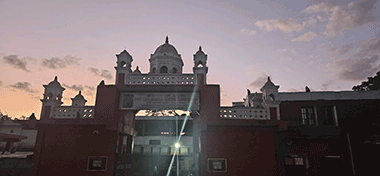
 The entrance to the complex itself is very attractive. The complex gives a fortified appearance with a central gateway that serves as the main entrance. The façade is enhanced by a bulbous dome, crowned with a kalasha (finial) and set on an octagonal base structure atop the main porch. Four square-based pavilions (chhatris) flanking the central dome add beauty to the dome. The presence of monkeys along the roofline is not merely incidental; it is an integral part of the temple’s identity.
Once entered, the devotees find themselves in an open space flanked by buildings on either side, which house the priests and trustees. At the far end on the right, there is a sheltered area for performing ‘havans’ on special occasions. On both ends of the open space, a bell post is present. Facing this area is a large rectangular hall, fully enclosed with grills and accessible through a small door. Once inside this hall, devotees could find the main temple on the right.
Garbhagraham of Shree Hanuman
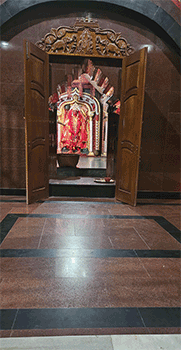
From the grilled hall, a passage of nearly ten feet in length with a hemicylindrical roofed archway leads to the Sannidhi of the main deity. This archway roof has a scalloped decorative finish. This passage opens into a granite-floored rectangular mini-hall, where devotees can have darshan of Lord Shree Mahabali in the Garbhagraham.
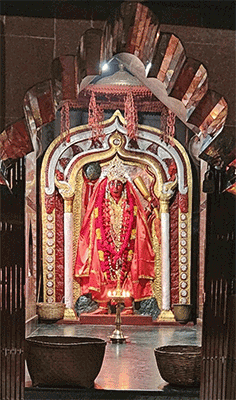 The entrance to the Garbhagraham is adorned with a heavy wooden lintel, intricately hand-carved image of Ganesha at the center, flanked by two elephants in the Gajalakshmi motif, symbolizing prosperity and protection. The Hanuman deity is enshrined within a beautifully ornate, illuminated golden frame (Prabhavali) in the sanctum.
The exterior of the Garbhagraham features a prominent red bulbous dome, supported by golden pillars at each of the four corners. This dome is reinforced by intersecting parabolic arches and is crowned by a golden, multi-tiered Kalash. Atop the Kalash is a 'neel-chakra' flag, held aloft by a staff.
Shree Mahabali Hanuman
The Shree Mahabali Hanuman idol stands nearly six feet tall, directly facing the devotees. The Lord is depicted in a standing posture, holding the Sanjeevi Parvath in His right hand and a mace in His left. He is adorned in a traditional Assamese-style dhoti (suriya), draped around the waist, with a shorter gamusa wrapped over it. His tail elegantly rises above His left shoulder, like a whip ready to lash at evil-doers. His hair (kesh) is meticulously styled and tightly tied. Notably, He wears no ornaments, which enhances His majestic presence. The simplicity of the Lord, without any vanity, is complemented by the radiance of His eyes. His eyes have a magnetic charisma, drawing all His devotees towards Him.
Location of the temple: "Shree Mahabali Hanuman Temple, Imphal, Manipur"
Experience
Darshan of simple looking “Mahabali” without any frill, bow before him with reverence. Devotee is sure to shed all his ego and vanity and come out pure with righteous thoughts.
OTHER INTERESTING TEMPLES
SRI HANUMAN THINKS DIFFERENTLY, THINKS FAST
THINKS AHEAD AND ACTS FOR SURE
Ed [March 2026]