
Temple built for Guru Sri Sethu Bhawa Swami of Ramadasi parampra
Sri Pratapah Veera Hanumar Temple
Moolai Ajaneyar Temple, Thanjavur, T
Nadu
gk kaushik

Thanjavur: **
Why name the city as Thanjavur?
Marathas’ of Thanjavur and Lord Anjaneya
Sri Pratapah Simhan and Sri Tulaja II
Temple for Lord Anjaneya
Uniqueness of the Sri Pratapah Veera Hanumar Temple
Historial facts
Sri Pratapah Veera Hanumar
Location of the temple: "Sri Moolai Anjaneya Temple, Thanjavur"
Experience
Thanjavur: **
Thanjavur, rightly acclaimed as the Granary of South India, lies in the deltaic region of the famous river Cauvery and is a cultural treasure house of Tamil Nadu. This was the Royal city of the Cholas, Khiliji, the Sultan of Delhi, Nayaks and the Marathas. The notable feature is that dispite several alien invasions, onslaughts and internal conflicts, the ancient culture and civilisation have not suffered much devastation. During the reign of Cholas, Thanjavur flourished humming with trade and cultural activities.
Why name the city as Thanjavur?
It is interesting to note that the place had been named Thanjavur by Shri Neelamega Perumal as a grant of a last wish of His devotee turned demon due to a curse. Tanjan got boons from Lord Siva became arrogant and started devastating the neighborhood. It is said that Sri Anaandavalli Thayar (Lakshmi) and Sri Neelamega Perumal (Vishnu) killed the demon Tanjan, as wished by Lord Siva ( Lord Tanjapuriswarar). As requested by the demon this place had been named after him as Thanjavur.
Marathas’ of Thanjavur and Lord Anjaneya
While Nayaks the rulers of Thanjavur were loyal to the Vijayanagar kingdom, Nayaks of Madurai (Alagiri) wanted to capture the power of Thanjavur. At that time General Venkaji alias Ekoji (1676-1683), the half-brother of Sivaji the Great defeated Alagiri and thus established the Maratha’s rule in Thanjavur 1676.
It is known that the followers of Vijayanagar Empire were devotees of Lord Anjaneya because of the influence of Saint Vyasaraja. The followers of Sivaji the Great were equally devoted to Lord Anjaneya because of the influence of Saint Samarth Ramadas. During these two dynasties, many temples for Lord Anjaneya and Lord Rama were built in and around Thanjavur. *** ((Bunk Nayak Anjaneya temple, Jaya Veera Anjaneya of punnayanallur, Bawa Swami Agraharam Thiruviyaru and also Puddu Agraharam))
Under the noble guidance of his Guru Sri Sethu Bhawa Swami, Sri Pratapah Simha had built this temple exclusively for Lord Anjaneya in Thanjavur. Normally temple for Lord Anjaneya will be small in size and built-up area. There will be no exclusive Rajagopuram or dwaja sthambam, but this temple is an exception.
Sri Pratapah Simhan and Sri Tulaja II
Thanjavur was under the rule of Maratha king Sri Pratapah Simha during the period 1739-1763, subsequently by his son Sri Tulaja II. The Marathas were facing trouble from the Nawabs of Arcot during this period. The capital town of Thanjavur was expanding and Pratapah Simha had then taken up the development of the town in a systematic way. During his regime, he built temples and chatrams (wayside rest houses). Sri Sethu Bhawa Swami was his guru. Sri Sethu Bhawa Swami was living in Thiruviyar a small village near Thanjavur just near iyarappan temple (see "Bawa Swami Agraharam Thiruviyaru Anjaneya temple" also). During their rule, the father and son had patronized many religious activities and cultural activities in and around Thanjavur, which transcended the boundaries of religion itself. Patronising the construction of minars for Nagoor Dargah by Sri Vera Prataph Simha and the patronisation of Melattur Bhagavathamela troupe by Tulaja II during 1787-88 are worth mentioning.
Temple for Lord Anjaneya
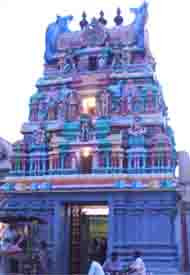 Under the noble guidance of his Guru Sri Sethu Bhawa Swami, Sri Pratapah Simha had built a temple
exclusively for Lord Anjaneya in Thanjavur. Normally temple for Lord Anjaneya will be small in size
and built-up area. There will be no exclusive Rajagopuram or dwaja sthamba, but this temple is
an exception. This temple has a three-tier rajagopuram and a dwaja sthamba. It has an
eighteen-pillered alankara mandapam. This is the second largest ancient temple built
exclusively for the Lord with Rajagopuram and dwaja sthamba, I had come across and the other
being the temple in Iyenkulam near
Kanchipuram. **** The Lord of this temple built by Sri Veera Pratapah Simha is known by the ‘Sri
Pratapah Veera Hanumar’. But this temple is known as 'Moolai Anjaneya' temple, moolai in Tamil
means corner.
Under the noble guidance of his Guru Sri Sethu Bhawa Swami, Sri Pratapah Simha had built a temple
exclusively for Lord Anjaneya in Thanjavur. Normally temple for Lord Anjaneya will be small in size
and built-up area. There will be no exclusive Rajagopuram or dwaja sthamba, but this temple is
an exception. This temple has a three-tier rajagopuram and a dwaja sthamba. It has an
eighteen-pillered alankara mandapam. This is the second largest ancient temple built
exclusively for the Lord with Rajagopuram and dwaja sthamba, I had come across and the other
being the temple in Iyenkulam near
Kanchipuram. **** The Lord of this temple built by Sri Veera Pratapah Simha is known by the ‘Sri
Pratapah Veera Hanumar’. But this temple is known as 'Moolai Anjaneya' temple, moolai in Tamil
means corner.
Uniqueness of the Sri Pratapah Veera Hanumar Temple
This temple had been planned and built in the North-West corner of then Thanjavur. The North-West corner is also known as ‘Vayu moolai’ in accordance with Vasthu Sastra, and since Lord Anjaneya is the son of Vayu (hence Vayusutha:) this corner acquires special significance for the Lord Anjaneya. For this reason the temple came to be known as moolai Anajaneyar koil.
There is complete Rasi Mandalalm [the twelve houses of the various Grahas as generally represented in a birth chart] is depicted nicely on the inside of the roof and it is believed that the wishes of the devotees will be fulfilled if they stand on the floor corresponding to their Rasi while praying to Sri Anjaneya Murthy.
There is a depiction of Rahu graham trying to catch the Surya (Sun) and Chandra (Moon) grahas on the inside of the roof of the mandapam, reminding you of the valor of the Lord Anjaneya during his early age.
In the pillar just nearby there is a depiction of two Nagams (snakes) worshiping the Lord Siva.
There are two sculptures on the Northern wall of the sanctorum depicting Lord Anjaneya in Yoga posture sitting on the top of the mountain. There are animals and trees shown in the mountain. Yoga Anjaneya is seen with four arms, while the top hands are seen holding sangu and chakram (couch and disk) while the other two are seen blessing with ‘abhaya and varadha mudras’. One depicts the Lord being worshiped by Veera Pratabah Simha and in the other it is his son Tulaja II. These Yoga Anjaneyas are seen facing north, hence it is said that praying Him will give Siddhi.
Historial facts
When Hindu temples were hunted for treasure by the nonbelievers, Utsava Murthi Vigrahas of many important temples were hidden by the devotees from the prying eyes of the enemies. Daily poojas were performed to Utsava Murthis while in transit from one place to another. Those days after the fall of mighty Vijayanagar there were few Hindu Rajyas in the South. Thanjavur under the Marathas were one among them. Many of the Utsava Murthis of the main temples took refuge in Udiyar Pallayam Siva temple and Perumal temple. When Kanchipuram was also attacked and hunted for Gold and other treasures of the temple, the Utsava Vigraha of Sri Kamakshi known as Bangaru Kamakshi was also moved from Kanchipuram for Udiyar Pallayam. Udiyar Pallayam was then under the rule of Thanjavur Maharaja Sri Pratapah Simha. Sri Sri Kanchi Kamakoti Petam had also moved from turbulent Kanchipuram to Udiyar Pallayam. The Thanjavur Maharaja Sri Pratapah Simha requested the then Acharya of Sri Sri Kanchi Mutt to move the mutt to Thanjavur. But the then 62nd Acharya of the mutt Sri Sri Chandrasekharendra Saraswati Swamigal IV (1746-1783 AD) accepted the request and moved the headquarters of the Mutt to Kumbakonam in the banks of river Kaveri. The Utsava Murthi of Sri Kanchi Sri Kamakshi known as Sri Bangaru Kamakshi was decided to be moved to Thanjavur. It is said that when Bangaru Kamakshi arrived at Thanjavur she was received by the Royal family and was accommodated in the Pratapah Veera Hanumar temple. Presently Sri Bangaru Kamakshi (immortalised in Syama Sastri's songs) has her temple built by Tulaja II in West Street very near to this temple. Even today before the beginning of the annual festival in Sri Bangaru Kamakshi temple, a handful of sand is taken from Pratapah Veera Hanumar temple.
It is said that Saint Sri Sethu Bhawa Swami had established the temple poojas to be performed in accordance with tradition, and the neem tree as sthala virsham. But presently the poojas are being performed as per vaikanasa agama vidi.
Sri Pratapah Veera Hanumar
Sri Pratapah Veera Hanumar (Lord Anjaneya) is in ardha shila form and is facing east and Lord Anjaneya is facing north. He is seen blessing devotees with his right hand which is in ‘Abya mudra’. The upward-looking golden eyes bless the devotees with a lot of self-confidence in their endeavor, which brings all prosperity in life.
Location of the temple: "Sri Moolai Anjaneya Temple, Thanjavur"
Experience
Next time when you are around Thanjavur make it a point to visit this beautiful temple and bring back the blessing of the Lord (of) Veera Pratapah.
OTHER INTERESTING TEMPLES
SRI HANUMAN THINKS DIFFERENTLY, THINKS FAST
THINKS AHEAD AND ACTS FOR SURE
Ed [Feb. 2006]
Updates: [Jan 2025]
** for more details on Thanjavur, palace, forts etc., please turn to page on “Bunk Nayak Anjaneya
temple” in our site.
*** read also Bunk Nayak Anjaneya temple, Jaya Veera Anjaneya of punnayanallur,
Bawa Swami
Agraharam
Thiruviyaru and also Puddu Agraharam
**** read details about the Iyenkulam temple in our site.