

Thiruviyaru
Thiruviyar kshethra got its name because there are five rivers namely Kaveri, Kudamuruti, Vennaru, Vettaru, and Vadavaru flow through this place. Iy means five and aarru means river in Tamil, hence the name Thiruviyaru. This place is very popular among the lovers of Carnatic music since it is in this kshetra the Saint Thyagaraja spent most of the time and obtained moksha. Saint Thyagaraja is devoted to Lord Rama and many of his compositions are in praise of Lord Rama, and it said that he had been graced by the darshan of the Lord himself. Every year on the Bagula Panchami day the saint's aradhana day is observed, and the entire leading musician finds it a privilege to participate in the function and sing the Pancharathna kriti in front of the samathi of this great saint. It is almost a pilgrimage for all the music lovers to this place during this time.
Iyyarappan temple
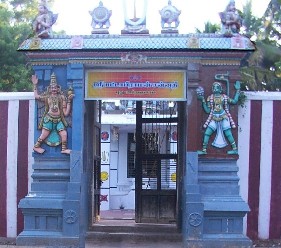 The main temple of this kshethra is that of Lord Siva presiding over as Iyyarappan (Tamil name) or
Panchanathiswar (Sanskrit name) and the Sakthi is known by the name Dharmasamvarthini. The temple
built during the Cholas period is very huge. There are many Nayanmargals who have sung in praise of
this Lord. Lord is Swayambhu and is of mud, hence there is no abishekam for the Lord. From the
southwest corner of the third prakaram if you spell 'Iyaara' you will be astonished to
hear the same echoing seven times.
The main temple of this kshethra is that of Lord Siva presiding over as Iyyarappan (Tamil name) or
Panchanathiswar (Sanskrit name) and the Sakthi is known by the name Dharmasamvarthini. The temple
built during the Cholas period is very huge. There are many Nayanmargals who have sung in praise of
this Lord. Lord is Swayambhu and is of mud, hence there is no abishekam for the Lord. From the
southwest corner of the third prakaram if you spell 'Iyaara' you will be astonished to
hear the same echoing seven times.
Uniqueness of Dharmasamvarthini temple
As in the case of other Siva temples the Sannidhi for the Ambal is not in the same compound. Ambal of this kshethra is Dharmasamvarthini and Her Sannidhi is in a separate compound abetting the main temple hence known as Dharmasamvarthini temple. Another unique point to note is that while in all the Siva temples the Ambal is seen facing Southwards here in this kshetra she is seen facing eastwards.
From these uniqueness of the present Dharmasamvarthini temple and the difference in the construction style and the materials used with that of the Iyearrapan temple, it is said that Dharmasamvarthini Sannidhi was shifted to the present place. It is also said that the Sri Rama temple was in existence at this place.
Maratha queen Mohanambal and Sri Rama temple
The Maratha queen by name Mohanambal had established a new town on the southern bank of the river Kaveri, and named it 'Panchanatha mohanambal puram'. She had brought in many scholars and pundits to the new town hence the place is also known as 'pudhu agraharam' which still it retains. Queen Mohanambal fell in love with the striking beauty of Sri Rama and his parivara, at the Sri Rama temple adjacent to the Iyerrapan temple on the northern bank of the river Kaveri. She decided to shift this temple to the new town on the southern bank named after her.
It is unique to this temple that both the moolavar and the uthsava murthis are in the same posture, unlike in other temples, where they are in a different posture. The uthsava Sri Rama is seen sitting in the veerasana and giving out vyakyana holding his hand in the 'thathwa gyana' mudra.
Presently the temple, which is in pudhu agraharam, is known as "Sri Pattabi Raman Koil" and is maintained by Sri Ramabhadracharyar, from the meager donations received from the devotees. The temple is well maintained and daily arathanas are performed as per the prescribed rules.
Sri Rama and His parivara
It is a wonderful sight to look at the majestically posing Lord Rama and his parivara. The description of the Lord quite fits the dhyna sloka :
vaithehi sahitham surathrumathale heme mahamandape
madhye-pushpaka-maasane manimaye veerasane susdhitham
aghre vasayathi prapanjanasuthe thathvam munibyeh param
vyaakiyaantham bhrathathibih parivrithem ramam baje shyamalam
vame bhumisuthaa purachcha hanuman pachchaath sumithraasudhah
sathrukno barathachcha parchvadhalayoor vaayvaathigooneesho cha
sugreevachcha vebhishanachcha yuvaraat tharasutho jambavaan
madyee neelasarooja-koomalarucheem ramam baje shyamalam
Sri Rama is seen sitting in veerasana and His left hand is resting on the knee and the right hand is showing 'gyana mudra'. Sri Anjaneya is seen holding the lotus feet of his Lord with one hand and the other hand is seen in 'dasa bhava' close to his mouth. On to the left of the Lord, (vame bhumisuthaa) Sri Sita Devi is seen holding lotus on one hand and the other is seen as 'ishwarya dhaana hastha'. Normally it is always customary to have Sri Devi on to the right of the Lord of the kshethra. This is unique in this kshetra that Sri Devi is seen on His left. By her stands Sri Shathrugun waving the royal fan. On the right of the Lord Rama stands Sri Lakshman with the folded hands. Sri Bharatha is seen standing on his side holding the royal umbrella. The wonderful scene of Lord Rama's parivara beholds the breath of the devotees. The most mesmerising of this parivara is the Lord Anjaneya on the left front in the sitting posture holding veena, singing Ramaganam.
Unique uthsava murthis
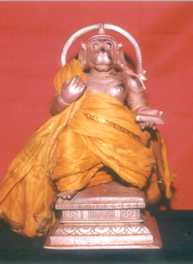 It is unique of this temple that both the moolavar and the uthsava murthis are in the
same posture. Normally this arrangement of moolavar and uthsava vighrahas in the same
posture does not exist in any temple. The uthsava Sri Rama is seen sitting in the
veerasana and giving out vyakyana holding his hand in the 'thathwa gyana' mudra. His
parivar is seen in the posture as described above.
It is unique of this temple that both the moolavar and the uthsava murthis are in the
same posture. Normally this arrangement of moolavar and uthsava vighrahas in the same
posture does not exist in any temple. The uthsava Sri Rama is seen sitting in the
veerasana and giving out vyakyana holding his hand in the 'thathwa gyana' mudra. His
parivar is seen in the posture as described above.
Another uniqueness of the Sri Lakshmana is that he holds the bow of Sri Rama along with his. As a dasa of the Lord Rama, he is seen fanning the Lord with the samaram (royal fan).
The third uniqueness is that Sri Anjaneya is seen sitting on his knees holding Ramayana in one hand and on the other hand he has kept in a posture as if he is holding japamala.
Trinities of carnatic music
The three tycoons of Carnatic music known as Sangeetha Trimurthi are Saint Tyagaraja, Sri Muthuswamy Dhikshathar and Sri Shyama Shastrigal. Legend has it that Saint Tyagaraja the follower of the Narada tradition was gifted with the "swararnavam" palm leaves by Saint Narada. Sri Muthuswamy Dhikshathar is a follower of the Hanumath tradition. Sri Muthuswamy Dhikshathar visited Thruviyar invited by Sri Tyagaraja. On a Sri Rama Navami day Sri Dhikshathar came along with Sri Tyagaraja and had darshan of Sri Pattabhi Raman of this temple and sang a composition "Mamava sri pattabhi Rama…" in raga manirungu. This temple has the uniqueness of having been worshiped by both these tycoons.
Pancha anupam (uniqueness) of this temple
Firstly Sri Sita Devi is seen on the left side of the Lord as described in "vaithehi sahitham…" which is not found in any other temple.
Secondly, Sri Anjaneya is seen holding the lotus feet of his Lord with one hand and the other hand is seen in 'dasa bhava' close to his mouth, which is not found in any other temple.
Thirdly both the moolavar and the uthsava murthis are in the same posture, which is not found in any other temple.
Fourthly uthsava Sri Lakshmana is holding the bow of Sri Rama along with his, which is not found in any other temple.
Fifthly uthsava Sri Anjaneya is seen sitting on his knees holding Ramayana in one hand and on the other hand he has kept in a posture as if he is holding japamala, which is not found in any other temple.
Present temple
The temple does not have Rajagouparam and as you enter the temple you are welcomed by the dwaja stampa and bali peedam. Sri Garuda and Sri Prassanna Anjaneya in the mandapam near dwaja are seen with folded hands facing the Sri Rama parivara. After taking permission from them you enter the main mandapam and you can the Garbhagraham. The temple does not have any income other than the denotations from the devotees. With the meager income, the temple is run efficiently with the daily puja as per the norms specified under agama rules. The devotees who are interested in helping a noble cause of the upkeep of this unique temple in many ways may contact the octogen aarathagar Sri. Ramabhadracharyar.
[ update : Sri. Ramabhadracharyar's son Shri Ravichandran is presently performing Pooja. Praying for the welfare of all. -Sep 2020]
Location of the temple: "Sri Pattabiramar Temple, Pudu Agraharam, Thiruviyaru"
Experience
Wherever you are make it a point to help the upkeep of this Pancha anupam temple of Pancha nadi kshetra in the way, you think is befitting to this temple. Make a visit to this temple once in your lifetime.
SRI HANUMAN THINKS DIFFERENTLY, THINKS FAST
THINKS AHEAD AND ACTS FOR SURE
Ed [Dec. 2005]
Updates: [Jan 2025]