
Bhadrachalam
Bhardrachalam, the abode of Lord Sri Rama, had derived the name from Bhadra, the saint—achalam (hill). Sri Bhadra, son of Meru and Menaka, had done penance at this hillock for having dharshan of Lord Sri Rama. Bhardrachalam, situated on the northern bank of the holy river Godavari, is a famous pilgrim center. Sri Vaikunta Rama temple is on the top of a small hill at this pilgrim center. The place is in Andhra Pradesh, in Khammam district. The nearest railway station is Kothagudem, Bhadrachalam-Road station, which is around 40 km from the pilgrim town. Public transport is available from the railway station, apart from taxis.
Sri Vaikunta Rama
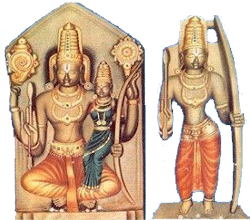 Sri Rama here is in a very unique posture in many ways. The Lord reveals his full four-armed form in this temple, holding a bow and arrow in His lower hands and Sankhu and Chakram in His upper hands. Sri Rama is seen seated in yogic posture with Sri Sitadevi sitting on His left lap. Standing next to Him is Sri Lakshmana with a bow and arrow, affectionately guarding them. All three have their right hands in the abhaya mudra, but interestingly, both Sri Rama and Sri Lakshmana hold an arrow in the same mudra. Another interesting aspect of the Lord's form is that the Lord holds His divine armaments, Sankhu and Chakram, in the reverse posture. Lord holds Sankhu in His right hand and Chakram in His left hand, unlike in other places. It is believed that the Lord holds the Sankhu in His right hand in order to blow the Sankhu to announce His arrival to Saint Sri Bhadra, who was on penance.
Temple of Vaikunta Rama
During the seventeenth century, Pokala Dhammakka, a descendant of Bhaktha Sabari of the Ramayana period, was living in Bhadrireddypalem, a place near the present Bhadrachalam. She too is an ardent devotee of Sri Rama. The presence of Vaikunta Rama and other deities in the middle of the jungle was revealed to this pious and devoted woman in a dream. She then spotted the site as indicated in the dream, cleared the jungle, and offered puja to the deities. With the help of local villagers, she constructed a small temple for the deities. But the present temple at Bhadrachalam was constructed by Bhakta Ramdas, and the construction of the temple premises is in itself an epic. This temple and its deities played an important role in the life of Ramadasa.
Readers may also kindly see "Sri Anjaneya, Sri Vaikuntha Rama temple, Bhadrachalam" for information about this tempele.
Bhakta Ramadasa
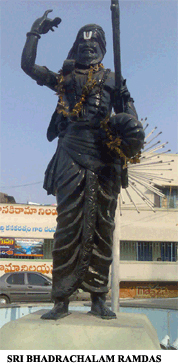 Sri Kancharla Gopanna, popularly known as Bhakta Ramadasa or Bhadrachala Ramadasa, was born in 1620 AD at Nelakondapalli village of Khammam in Andhra Pradesh and lived for 68 years on this earth.
As per the last verse of his Dasarathi Satakam, his name was Gopanna, the son of Linganna Mantri of Atreya Gotram. The Mantri surname is because of the fact that their ancestors were ministers of the then King. Born to pious couples Linganna Murthy and Kamamba, Gopanna was brought up as a pious and devoted gentleman. He had developed a good taste for music and was an ardent devotee of Lord Rama. As a good singer, he devoted his talents to singing in praise of Lord Rama. Many of his cousins and nephews were working in the administration of the royal Treasury. His nephew Akkanna, who was in the court of then Sultan Taani Shah of Golconda (Abdul Hasan Tana Shah, the Nawab of the Qutub Shahi dynasty), had appointed Goppanna as Tahsildar of the present Bhadrachalam region.
Construction of Ram temple by Bhakta Ramadasa
As a Rama Bhakta, Sri Goppanna, while conducting his routines of collection of taxes for the royal treasury, devoted time to spreading Rama-nama also. During the course of his duty, he visited the temple of Lord Vaikunta Rama at Bhadrachalam. The Rama Bhaktha in him was overwhelmed at the sight of Lord Vaikunta Rama. The temple then was not in good shape, and Goppanna thought that the temple required renovation and reconstruction. He made an appeal to the people of the region to raise funds to this effect. Basically an agriculture-dependent society, they told him to use the tax collected with a promise to replenish the fund after the harvest. In the hope he will be able to replenish the amount in time, Goppanna spent the tax money towards the construction of the temple.
His ‘Dasaradhi Sathakam’ are reflection of the deeply felt bittersweet agonies and ecstasies of a devotee in distress in the form of ‘keertanas’. The outpour from the anguished heart of His Baktha made Sri Rama and Sri Lakshmana go to the Sultan’s palace on that very night.
After accomplishing the task of constructing the temple for Sri Vaikunta Rama, he offered his prayers to Sri Hanuman. This poetic submission to Lord Hanuman is known as “Sri Anjaneya curnica," a sort of harmonious prose, not divided into prosodial feet but with the unbroken sentence running on continuously. Readers can find the same in Tamil script on our page: "Sri Anjaneya Curnica."
After completion of the construction, his miseries started. Sultan Taani Shah of Golconda had come to know of what Goppanna had done in Bhadrachalam, and he dismissed Goppanna from service for misappropriation of royal funds and sentenced him to twelve years of imprisonment. Goppanna was kept in prison in Golkonda and tortured by the Sultan. Twelve long years he was kept there and tortured. Goppanna sought refuge in singing to Lord Rama to get away from the miseries he had to undergo. The outpour from his anguished heart is now popularly known as ‘Dasaradhi Sathakam’. His songs are a reflection of the deeply felt bittersweet agonies and ecstasies of a devotee in distress in the form of ‘keertanas’.
Repayment of Goppanna’s debt by Lord Sri Rama.
On hearing His Baktha’s anguish, Sri Rama and Sri Lakshmana went to the Sultan’s palace on that very night. Woke Sultan and paid the money due to the royal treasury through Goppanna. Sultan was perplexed to see the divine-looking young lads repaying the money due from Goppanna. The young lads got the release papers signed by the Sultan. Unaware about the repayment of the money, next morning Goppanna had found the release papers signed by Sultan at his bedside. To the astonishment of Sultan, the release papers were presented from the prison the next morning. The mohars repaid by the Lord were brought in front of the Sultan in the morning. The mohars had the Pattabhishekam scene on one side and the picture of another Rama Bhaktha, Anjaneya, on the other side.
Bhakta Ramadasa, the role model
Sultan now realised that he had made a grave mistake by imprisoning Goppanna the Rama Baktha, and the two young lads are none other than Lord Rama and Lakshmana. He gave all the mohars back to Goppanna and requested Sri Ramadasa to continue his work in Bhadrachalam. The golden coins paid by Sri Rama are known as Ram Tanka coins. They can be seen even today at Sri Sita Ramachandra Swamy Vaari Devasthanm at Bhadrachalam. Goppanna the Ramadasa spent the rest of his life and composed moving poems that inspired Saint Thyagaraja later.
|| jaanaki jeevana smaraN jaya jaya raama ||
|| deera shuraveera hanumantuni ki jaya ||
Ed [21st April 2003]