
Birth of Narayan
Saint Shri Samarth Ramdas was born in 1608 A.D. in the village Jaamb, in Marathwada, on the auspicious day of Ramnavmi as the second son to the pious couple Suryaji Panth and Renuka Bai. His parents named him Narayan. His elder brother was Gangashar Shastri, alias Sheshta.
In the year 1620, all arrangements were made for Narayan’s wedding. He sat in front of the bride. As a part of the wedding ritual, a screen was placed between the bridegroom and the bride. And when the priests started chanting "Sawadhan!" which means 'alert, oh! Bridegroom’, Narayan vanished from the scene in a twinkling of an eye.
Renunciation
From there he went to village Takli near Nasik. There he practiced meditation of Gayatri and Rama Mantra. He chanted the mantras standing in knee-deep water from early morning till noon. By raising alms, he took his prasad and attended spiritual discourses in his free time. The discoursers were at various temples in Nasik and Panchavati.
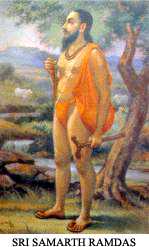 Ramdas also studied Sanskrit and copied the Ramayana of Valmiki in his own handwriting. His manuscript of Valmiki Ramayan is still preserved in the collection of Sri S.S. Dev of Dhubliah. This shows his knowledge of Sanskrit; he got the blessings of Sri Ram after a rigorous penance of ‘rama japa’ for twelve years. Later, he came to be known as Samarth Ramdas. This mantra of thirteen letters, "Sri Ram Jaya Ram Jaya Jaya Ram," was chanted by him thirteen lakh times at Takali, near Nasik, on the banks of the Godavari.
Readers may like to read our article "Gomay-Maruti – Sri Samarth Ramdas Mutt, Takli, Nashik" for more information.
Pilgrimage
On attaining the age of twenty-four, he started moving on pilgrimage and for nearly twelve years travelled all over India, such as Haridwar, Kasi, etc. The tradition says that Lord Panduranga Vittal Himself appeared before Ramdas and took him for the visit to Pandharpur and gave him dharshan as Sri Rama. In Pandharpur, Ramdas came in contact with Tukaram and other saints of Pandharpur. Both the saints had spread the message of Bakthi by travelling together.
On an occasion, when these two were on pilgrimage to Moorey Geon, Sri Genasha, the presiding deity of Mayureswar had given dharshan to these saints as Panduranga Vittal and Sri Rama at the same time. Even today, the invoking prayer of Sri Genasha at this temple is the one that was composed by Ramdas. In his pilgrimages, Ramdas observed and studied the social, political, and economic conditions of Indians and their utter helplessness in life. He started the mission for the upliftment of mankind.
After a rigorous penance of ‘rama japa’ for twelve years, he was blessed by Sri Rama, and came to be known as Samarth Ramdas. The mantra of thirteen letters, "Sri Ram Jaya Ram Jaya Jaya Ram," was chanted by him thirteen lakh times at Takali, near Nasik.
Guru of Chhatrapati Veer Shivaji
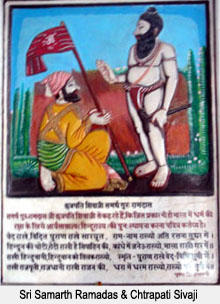
Ramdas went about preaching his philosophy along the banks of the Krishna River between Mahabaleswar and Kholapur. At Singanvadi, Ramdas met Chhatrapati Veer Shivaji, the then ruler of Maharashtra.
Shivaji became an ardent devotee of Ramadas. Being an ardent devotee of Sri Rama and Maruti (Anjenaya), he installed shrines of Rama at Champavati and established eleven principal seats of Maruthi. At that time, under Shivaji’s rule, some territories were under the tyranny of foreign rulers. In adopting the principals of his Guru Samarth Ramdas, he was able to bring peace and harmony to his country and countrymen.
Teachings and Religious Activity
 His inspiring teachings in the pragmatic treatise 'Dasbodh' were written at 'Shivthar' a place, which is virtually heaven on earth. The literary works of Ramdas such as Dasabodh, Manache Shlok (verse addressed to the mind), Karunashtakas (hymns to God), and Ramayana (describing only the conquest of Lanka by Sri Rama and the vanquishing of Ravana) are very popular. To men really interested in his teachings, he gave the “thryodhashari“ mantra "Sri Ram Jaya Ram Jaya Jaya Ram.".
Ramdas had many disciples, including many noble women. The women disciples were also expert preachers and were virtuous. Ramdas sent his disciples to all parts of India to spread the Hindu religion. His disciples and Mutts in the North directly or indirectly helped Shivaji and his work. Ramdas's organisation had spread to the south also, with Thanjavur as the center. Ramdas appointed Bhimaswami, his direct disciple, as the Mahant of the Thanjavur Mutt.
Mukti Days
In his last days, Ramdas devoted his time to literary activity and building up his mutt in various corners of India. It was as a tribute to Ramdas's extraordinary patience and determination in restoring the glory of the Hindu religion in India that people named him Samarth (all-powerful) Ramdas, a name that he richly deserved. This great Guru of Maharashtra breathed his last on the 'Navami' in 'Maagh', 1681, at Sajjangad, near Satara, a fortress, which was given to him by Shivaji for his residence. His samadhi at Sajjangad inspires the devotees for self-elevation and supreme excellence in every segment of life.
The last instructions of Ramdas to his disciples were: "Do not think much of your bodily wants. Have Satsang with devotees. Keep the image of Lord Rama in your heart. Repeat the name of Lord Rama always. Annihilate lust, greed, anger, hatred, and egoism. See Lord Rama in all creatures. Love all. Feel His presence everywhere. Live for Him alone. Serve Him in all beings. Make total and unreserved surrender unto Him. You will always live in Him alone. You will attain immortality and eternal bliss.".
|| Sri Ram Jaya Ram Jaya Jaya Ram ||
|| Sri Ram Jaya Ram Jaya Jaya Ram ||
Ed [14th September 2002]