
Reincarnation of Lord Vayu
It is believed that Sri Hanuman, Bheema, and Madhwa are the three manifestations of the Wind God, Vayu. In the name of Hanuman, he served Lord Rama. As Bheema, he served Sri Krishna. And again, he chose to serve Lord Sri Vedavyasa in the name of Sri Madhwa.
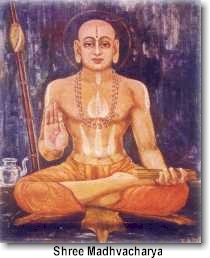
Sri Madhwacharya, regarded as an incarnation of Vayu, the Wind God, was born in the year 1238 A.D. He was born of Madhya Geha, a Tulu Barhmin, and Vedavati at Paajaka near Udipi in the South Kanara district of Karnataka. The father gave him the name Vasudeva.
Childhood of Sri Madhwa
Madhwa distinguished himself in physical exercises and field games. He had a wonderful physique. He could wrestle, run, jump, and swim. So people gave him the nickname Bhima. Madhwa took to the study of the Vedas and the Vedandas and became well versed in them. His upanayanam was performed at the age of five. He took Sannyasa in his eleventh year. Sri Achyutapashacharya initiated him into sanyasa with Purna Prajna as ashrama name. Sri Madhwa became a Sanyasi on Vijaya Dasami day of Vilambi year as per Hindu calendar. Mostly this day comes in October. Even today, Maadhwas celebrate Vijaya Dasami as Madhwa Jayanti also.
Pancha-bheda—five real and eternal distinctions are the distinction between one Jiva and another Jiva (jeeva-jeeva), between the Jiva and matter (jeeva-jata), between one piece of matter and another (jata-jata), between matter and spirit (Jata-Deva), between the Supreme Being and the individual soul (Deva-Jeeva).
Sri Madhwa, head of the mutt
Sri Achyutapashacharya made Madhwa the head of the Mutt in his place; by virtue of this, he is known as Ananda Tirtha. He went on an extensive tour in southern and northern India to preach his gospel of Bhakti. He had written thirty-seven gradhas like Geetha Bhasyam, Suthra Bhasyam, and Anuubhasyam. Anuvyakyam. It is believed that by pronouncing the names of those thirty-seven grandas itself, one gets sanctified.
Miracles performed by Sri Madhwacharya
Sri Madhwacharya had performed many miracles. Then Sri Madhwacharya was camping in Srimushnam, a place twenty-six kilometres from Chidambaram in Tamil Nadu, observing the Chathur masa vritha. To squelch the thirst of a pregnant lady, he produced water with his Danda. The Danda Teertha in Srimushnam is a notable holy spot for Maadhwas. On an occasion, he stilled the waves of the ocean when he went to take a bath. On another occasion, he was on the beach of Malpe composing a hymn. He sighted a ship that was caught in the storm and, by waving his hand, saved it from being capsized. The captain of the ship had offered him a lump of Sandal paste as a gift, which the Sri Madhwacharya took. When the sandal paste lump was broken open, an idol of Lord Krishna was found. Sri Madhwacharya had the intuition that this idol of Lord Krishna is the one that was worshipped in Dwaraka by Shri Rukmani. He installed the idol at Udipi. He had established the eight mutts in Udipi to spread the Dvaita philosophy and to worship the Lord Krishna in Udipi.
Sri Madhwacharya's Dvaita
Sri Madhwacharya is the great exponent of the Dvaita School of philosophy. Dvaita is employed to indicate this difference between God's infinite perfection and the finiteness of everything else. His Vaishnavism is called Sad-Vaishnavism in order to distinguish it from the Sri-Vaishnavism of Ramanujacharya. According to his philosophy, the Supreme Being is Vishnu, or Narayana. This universe is real and is not Mithya or an illusion. The finite beings comprising the universe are subject to a system of gradation, beginning with the Goddess Laxmi, followed by other minor gods, seers, human beings, and undivine beings. The rank of any soul in this scheme of gradation depends on the degree of its devotion to God. God is an embodiment of all virtues and excellences and ever remains untouched by any kind of blemish (Dosha). He has countless Roopas and forms.
Pancha-bheda
 Every follower of the Madhwa School should have a firm belief in the Pancha-bheda—five real and eternal distinctions. The distinction between one Jiva and another Jiva (jeeva-jeeva), between the Jiva and matter (jeeva-jata), between one piece of matter and another (jata-jata), between matter and spirit (Jata-Deva), between the Supreme Being and the individual soul (Deva-Jeeva).
The worship of Vishnu consists in (i) Ankana, marking the body with His symbols; (ii) Namakarana, giving the names of the Lord to children; and (iii) Bhajana, singing His glories. Sri Madhwacharya laid much stress on the constant practice of the remembrance of God (Smarana). He says, "Form a strong habit of remembering God. Then only it will be easy for you to remember Him at the moment of death."
Renunciation, devotion, and direct cognition of the Lord through meditation lead to the attainment of salvation. The aspirant should equip himself with the study of the Vedas, control of the senses, dispassion, and perfect self-surrender if he wants to have the vision of the Lord. These are some of the important teachings of Madhwacharya, the renowned exponent of the dualistic school of philosophy.
Unique revelation
Sri Trivikrama Panditacharya, contemporary of Sri Acharya Madhwa, had a unique sight of seeing Sri Madhwacharya worshipping Lord Krishna, and he was wonder struck to see the divine sight—Hanuman performing puja to Sri Rama, Bhima to Sri Krishna, and Madhwacharya to Sri Vaashsta Krishna (Sri Veda Vyasa). . It seems that Sri Madhwacharya had revelled to Sri Trivikrama Panditacharya that he is the third avathara of Vayu, the Wind God.
It is believed that even now Sri Madhwa is ever residing in Bhadrinath and learning from Sri Veda Vyasa.
|| Hari sarvothamaha Vayu jeevothmaha ||
||Mukhya Praanantargata Sitapati Sri Ramachandra preeyataam||
Ed [13.01.2002]