
Temple on piece of rock fallen from Sanjeevani parvat
Sri Veera Anjaneya Swamy Temple, Aragonda, Chitoor, Andhra Pradesh
sri g v r gupta, kanna mangalam, vellore

War in Lanka during Ramayana
Ravana the demon king of Lanka was advised by many including his brother Sri Vibishana to return Sri Sita Devi to Sri Rama and surrender (Saranagatham). All the good counsel to him fell on deaf ears and Ravana had shown no inclination to return Sri Sita Devi and in fact adamant not to do so. The inevitable war ensued between Sri Rama, ably assisted by the monkey and bear warriors and Ravana assisted by the demon warriors with maya sakthi.
During the war, Ravana had lost many of his able warriors, and Sri Rama's side was seeing the face of victory. Even then Ravana did not feel the necessity to surrender because of his vanity and unfound pride in Sri Sita Devi's capture. He sends for Inderjeet [Maganath] his only son now left behind with him. He instructs Inderjeet to march forward for the Warfield and blesses him for the victory.
Inderjeet in Warfield
 The son of Ravana who had won Lord Indra the leader of Devas gets the name Inderjeet, meaning the one
who had won Indra. Inderjeet enters the war field with all paraphernalia; matching his pomp he was
skilful in the warfare also. On the other side, Sri Rama was carried by Sri Hanuman, and Sri Lakshmana
was carried by Angadhan and was in the forefront. Neelan was asked by Sri Rama to be the back force.
When Inderjeet faces Sri Rama and Lakshmana, he cannot control wondering at the skill with which these
two were fighting. But in the back of his mind he was thinking about the killing of his brothers and
dear uncles by these two, the thought compounded as revenge. After a protracted fight with Lakshmana,
Inderjeet leaves the field through his magical power. On the sunset, Sri Rama leaves the battlefield
leaving Lakshmana to take stock of the effects of the day's war. On return to the palace, Inderjeet
sends Mahendra to the war field.
The son of Ravana who had won Lord Indra the leader of Devas gets the name Inderjeet, meaning the one
who had won Indra. Inderjeet enters the war field with all paraphernalia; matching his pomp he was
skilful in the warfare also. On the other side, Sri Rama was carried by Sri Hanuman, and Sri Lakshmana
was carried by Angadhan and was in the forefront. Neelan was asked by Sri Rama to be the back force.
When Inderjeet faces Sri Rama and Lakshmana, he cannot control wondering at the skill with which these
two were fighting. But in the back of his mind he was thinking about the killing of his brothers and
dear uncles by these two, the thought compounded as revenge. After a protracted fight with Lakshmana,
Inderjeet leaves the field through his magical power. On the sunset, Sri Rama leaves the battlefield
leaving Lakshmana to take stock of the effects of the day's war. On return to the palace, Inderjeet
sends Mahendra to the war field.
War continues
The fight continues with Mahendra leading the Ravana's side and Lakshmana, Sri Rama's side. Hanuman was fighting with Agamban. After killing Agamben, Hanuman goes to assist Lakshmana who was fighting deep in the battlefield surrounded by the Ravana's warriors. Under the advice Lakshmana spells pasupathastram, thereby killing all the force of Ravana.
Use of Brahmaastra
The news of the use of pasupathastram goes to Ravana and Inderjeet. Inderjeet thinks it is time to use the Brahmaastra on Lakshmana, and goes to war field. He remains invisible through his maya sakti and makes Mahendra look like Indra and fight Vanaras. The Vanaras and Lakshmana were wonder-struck at the sight of seeing Indra fighting them. At that moment Inderjeet releases Brahmaastra on Sri Rama's warriors.
Effect of Brahmaastra
Gloomy, is a simple word to describe the after effect of Brahmaastra. Poet Kamban says millions and millions of arrows had covered Lakshmana, millions of arrows on Hanuman, and tens of thousands of arrows struck Ankath, Neelan, etc. Inderjeet goes to Ravana to describe the events on the battlefield.
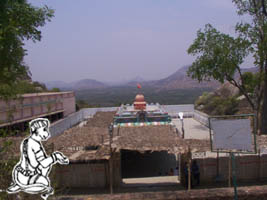
The picturesque sight of the place is mesmerising, with the medicinal mountain making the backdrop of the scene. There are at least two or three mountains that form the group of Sanjeevi Medicinal Mountain. The shortest of these is considered as the main Aragonda.
Sri Rama who was away from the battlefield entered the field to find all His men had fallen prey to the Brahmaastra. The sight was gory, and he went from one to other warriors. He finds Lakshmana fallen among the heap of arrows, and cannot bear the sight of his beloved brother fallen like this. The sorrow makes him weep and soon he falls unconscious.
A messenger of Ravana sees this and goes and reports to Ravana that both Rama and Lakshmana had fallen pray to the Brahmaastra. Believing it is true, Ravana rejoices, goes to Ashoka Vatika brings Sita by Pushpak vimana, and shows the fallen brothers on the battlefield, foisting unbearable pain on Sri Sita Devi.
Hanuman and Vibishana
Sri Vibishana who is a Chiranjeevi comes to the battlefield to assess the damage caused by the Brahmaastra. First looks for Hanuman and sees him in the near fainted condition. After administering the first aid to Hanuman, both go in search of long long-living Jambavan. Sri Jambavan who was half-conscious, on seeing Vibishana, asks about the Hanuman. On seeing Hanuman he cries "We all will rise and will raise", rejoicing. Sri Jambavan then tells about the medicinal herb that can revive Lakshmana. He describes the whereabouts of the herb and tells about the herb that can revive life, the herb that can be applied for fixing cut limbs, and the herb that can fix the skin thereby the body. He then instructs Hanuman to go after the herbs which are there in the blue mountain.
Medicinal Mountain [Sanjeevi parvath]
Hanuman understood the urgency and need for the herb takes a huge figure and leaps over the sky, leaving the sea behind. He flew over the sea, barath versh, Himalayas. He pays his respects to all the Gods and Devas and reaches the Medicinal mountain [Sanjeevi Parvath] welcoming Him. Kamban says the Hanuman who was golden in colour, the future Brahma; deathless Chiranjeevi saw the blue mountain. It was so black that it looked as if the dark had taken refuge in it. The Devas who were guarding the mountain asked him the reason for his coming. When the reason for his coming here was told, Devas requested Hanuman to return the mountain to the original place after the use of the required herbs.
Now Hanuman uproots the mountain and takes it to the battlefield in Lanka, passing through Barath versh, saving Lakshmana's life. Bringing back to lives many vanaras who lost lives, bringing back the limbs to the vanaras who lost limbs, and healing all the wounds of the vanaras. Just by simple and fast act, Hanuman puts back the Medicinal mountain [Sanjeevi parvath] in its original place as promised to the Devas.
Bits of medicinal mountain
Medicinal mountain [Sanjeevi parvath], being brought from its original place, is believed to have fallen in bits and pieces in many places en route. It is claimed that one such piece had fallen in the border of present Andhra and Tamil Nadu. Presently the place is known as Aragonda. Aragonda in Telugu means half hill, in Sanskrit it is known as Ardagiri. The place is located in Tavanam Palli Mandal of Chittor District of Andhra Pradesh. The famous Kanipakam Vinayaka temple is just ten kilometers away.
Sanjeevaraya Pushkarini
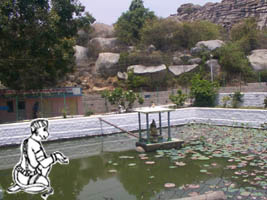 The picturesque sight of the place is mesmerising, with the medicinal mountain making the backdrop of
the scene. There are at least two or three mountains that form the group of Sanjeevi medicinal
mountain. The shortest of these is considered as the main Aragonda. On the top of the mountain, there
is a tank which is known as Sanjeevaraya Pushkarini. It is said that the tank is always full
and never dries up.
The picturesque sight of the place is mesmerising, with the medicinal mountain making the backdrop of
the scene. There are at least two or three mountains that form the group of Sanjeevi medicinal
mountain. The shortest of these is considered as the main Aragonda. On the top of the mountain, there
is a tank which is known as Sanjeevaraya Pushkarini. It is said that the tank is always full
and never dries up.
It is believed that the water from this Puskarini has a lot of medicinal value as of herbs of Sanjeevi mountain, and cures even diseases like TB, etc. The water from this Puskarini was not spoiled even after four months in our case.
Sri Veera Anjaneya Swamy Temple
The main mountain is about 300 feet high. A small temple was in existence in this kshetram for quite a long time, said to be from 300 years back. Today the temple has seen improvements. Even now the temple is quite small and maintains the sanctity. Though the main attraction here is the Puskaarini and Sri Veera Anjaneya, there is a small temple for the Vinayaka just before reaching the Hanuman temple. Recently a temple for Ayyappan had also been built on the hillock just opposite the Hanuman temple.
Sri Veera Anjaneya Swamy
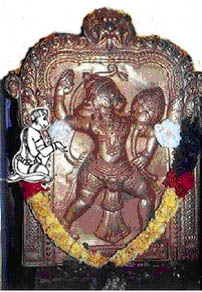 In the main sanctum sanctorum, the kaupinam wearing Sri Veera Anjaneya Swamy is facing north.
The nearly three feet idol is covered with copper plate. The embossment of the main deity is seen. His
right hand is showing Abhya mudra, in the left hand He is seen holding the sowganthika flower.
His tail is seen raised above the head and there is a small bell typical of Hanuman idols of Andhra
about 300-400 years old. He is seen wearing a beautiful kundalam (earring), and an ornamental
mala adorns His neck. His eyes are seen glowing.
In the main sanctum sanctorum, the kaupinam wearing Sri Veera Anjaneya Swamy is facing north.
The nearly three feet idol is covered with copper plate. The embossment of the main deity is seen. His
right hand is showing Abhya mudra, in the left hand He is seen holding the sowganthika flower.
His tail is seen raised above the head and there is a small bell typical of Hanuman idols of Andhra
about 300-400 years old. He is seen wearing a beautiful kundalam (earring), and an ornamental
mala adorns His neck. His eyes are seen glowing.
Festivals and Savas
From five thirty in the morning till nine in the night, the temple is open. Devotees are allowed in batches of fifty/sixty and the pooja is conducted and holy water and tulsi are given as prasad. Once that batch is over then the next batch of devotees is allowed. Devotees offer garlands made of flowers and ake (betel leaves). On the full moon day, the temple is open up to eleven in the night, there is a heavy rush of devotees on this day.
How to reach
There are direct buses from Chittoor and Kanipakkam to Aragonda. You can reach Chittoor from Vellore in Tamil Nadu. Once you are in the foot hills you can either choose to claim the hillock which may take up to thirty minutes or take the three-wheeler plying between foot to the top of the hill. There are a few shops on the top of the hill selling flowers, mala, cool drinks, coffee, or tea.
ref : kamba ramayanam published by Vardhaman & temple priest.
Location of the temple: "Sri Veera Anjaneya Swamy Temple, Aragonda, Chitoor"
Experience
The grace of the Lord Sanjeevaraya is sure to give us all a healthy and long life.
OTHER INTERESTING TEMPLES
SRI HANUMAN THINKS DIFFERENTLY, THINKS FAST
THINKS AHEAD AND ACTS FOR SURE
Ed [August 2009]
Updates: [Jan 2025]