
300 years old Pracheen Hanuman Mandir of Raipur
Sankata Mochan Hanuman of Sri Dudhadhari Temple
Raipur, Chhhattisgarh
sri subramanya swamy

Chhattisgarh
Thirty six in Hindi is Chhattis, garh is fort, house, etc, and hence the region which had thirty six forts were known as Chhattisgarh. This region which was part of Madhya Pradesh was curved out and a new state in the name of Chhattisgarh with Raipur as the capital of the state was formed on 1st November 2000. Though it is a common belief that there are thirty six forts there are forty-eight forts in the region. This region has its historical importance and was part of Kosal. It was under the Mourya Kingdom and also the Haihaya Kings. But the name of Chhattisgarh is not given in any record or inscription and it is more probable that the name is a corruption of Chedishgarh, meaning the forts of the lord of Chedi.
Raipur
The city was once the capital of Haihaya Kings, who were controlling the traditional forts of the Chattisgarh. Even today one can see the ruins of the old site and ruins of fort in the southern part of the city. It is believed that King Ramachandra of the Kalchuri dynasty founded the city after his son Brahmdeo Rai as “Raipur” and subsequently his son made it the capital of his kingdom. Some historians opine that Brahmdeo Rai had established this city in his name and shifted his capital from Khalwatika (now Khallari). The traditional importance was never lost for the city when it was attached to Central Province during Raj or Madhya Pradesh after independence. Today it had regained the glory of the Capital of a State.
Temples in Raipur
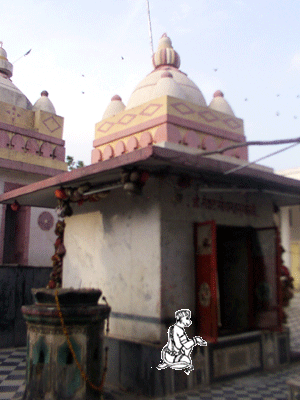 Though there are many temples today in the city of Raipur, the most revered by many are Jagannath,
Mahamaya, Vivekananda Ashram, Dudhadhari temple, Dudhadhari Matt, Balaji Mandir, Sankatmochan Hanuman,
Ram Panchayatan and Vir Hanuman temples. Out of these last six temples are centered on the ancient and
most revered Dudhadhari Mutt.
Though there are many temples today in the city of Raipur, the most revered by many are Jagannath,
Mahamaya, Vivekananda Ashram, Dudhadhari temple, Dudhadhari Matt, Balaji Mandir, Sankatmochan Hanuman,
Ram Panchayatan and Vir Hanuman temples. Out of these last six temples are centered on the ancient and
most revered Dudhadhari Mutt.
The name Dudhadhari
There lived a mahant by the name Swami Balbhadra Das who was an ardent devotee of Lord Hanuman. He was worshiping a swayambu Hanuman. He will offer milk as prasad to Hanumanji and the prasad he used to drink. As per the lore a cow by the name “Surhi” will visit the Mahant daily and offer her milk for Lord Hanuman. With time, Mahant Swami Balbhadra Das was taking that milk only as food, hence he was called “Dudh-Ahari”.
Balaji Mandir
Mahant Swami Balbhara Das had great following. The king of his time Sri Raghu Raoji Bhosle, ruler of the Nagpur region under whose jurisdiction the Raipur fell was an ardent follower of Mahant Swami Balbhara Dasji. The king was a great devotee of Sri Vishnu and wanted to build a temple for Sri Balaji at Raipur. He expressed his desire to Mahantji and as per advice of Mahantji it was decided to build the temple in the vicinity of Dudhadhari Mutt. An elegant temple for Sri Balaji was built in the year 1610 A.D. on the site near the place where Mahant Swami Balbhara Das was living. The walls are adorned with beautiful paintings from the life of Sri Rama. Even today we can see the well-preserved paintings. Presently there are some shaligrams which are in the place of worship in the Mandir.
Sri Balbhadra Das had worshipped Lord Hanuman throughout his life and was instrumental in the establishment of Sri Balaji Temple at Raipur. He had just milk for living in this world and served his king and people alike, blessing them and mitigating their ordeals. He had left us with a treasure in Sankata Mochan Hanuman.
Sankata Mochan Hanuman
A few days after the building of the Sri Balaji temple just behind the sannidhi of Hanuman worshiped by Mahant Dudhadhari a miracle happened. Sri Hanuman who is an adorent Rambaktha just turned His face to see Sri Balaji [Vishnu- Sri Rama] while his body remained the same way. Therefore this temple is unique in that the temple doorway and stairway do not face in the same direction as is the case of most temples. While the doors are facing south [towards Sri Balaji], the stairs are facing north. One can see this unique ancient Hanuman even today in the same posture. The Hanuman of this temple who had been worshipped by Swami Dudhadhari is named Sankata Mochan Hanuman, for He fences the ordeals faced by the devotees.
Rampanchayatan
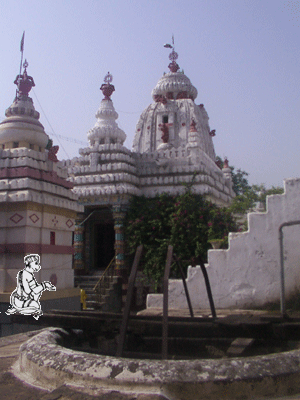 Just beside the Sri Balaji temple a beautiful temple for Sri Ram Parivar had been built by Sri
Jagannath Sav, twenty years after the establishment of Sri Balaji temple. Originally the statues of
Sri Rama, Sita Ma, Bharat, Lakshmana, and Shatrugan, made of wood were installed in the temple. Since
the temple had five members of Sri Ram Parivar, the temple got the name Sri
Rampanchayatan. In the year 1922, this temple underwent renovation and the main wooden statues
were replaced with marble statues. It is noteworthy that the statues of Sri Rama and Baratha are
black. The walls of this temple adorn beautifully curved scenes in stones depicting stories from two
great epics of India, Ramayan and Mahabharata.
Just beside the Sri Balaji temple a beautiful temple for Sri Ram Parivar had been built by Sri
Jagannath Sav, twenty years after the establishment of Sri Balaji temple. Originally the statues of
Sri Rama, Sita Ma, Bharat, Lakshmana, and Shatrugan, made of wood were installed in the temple. Since
the temple had five members of Sri Ram Parivar, the temple got the name Sri
Rampanchayatan. In the year 1922, this temple underwent renovation and the main wooden statues
were replaced with marble statues. It is noteworthy that the statues of Sri Rama and Baratha are
black. The walls of this temple adorn beautifully curved scenes in stones depicting stories from two
great epics of India, Ramayan and Mahabharata.
Veer Hanuman
Sri Ram Parivar is incomplete without Sri Hanuman. A small temple for Hanuman depicting Him as Veer Hanuman was built in front of Rampanchayatan temple. Veer Hanuman is holding Sanjivi Parvat in His left hand and on the right one is holding a mace. He is seen crushing Ahhi Ravana with His feet, depicting the story of the killing of Ahhi Ravana after the Rama- Ravana war.
Brindavan of Sri Dudhadhari
Sri Balbhadra Das had worshipped Lord Hanuman throughout his life and was instrumental in the establishment of the Sri Balaji Temple at Raipur. He had just milk for living in this world and served his king and people alike, blessing them and mitigating their ordeals. He had left us with a treasure in Sankata Mochan Hanuman. He had left his mortal body, but still, it believed that by seeking his and his Sankata Mochan Hanuman’s blessing one can overcome any amount of pressure and distress. The place where he left this world a Brindavan had been made. Even today devotees throng this Brindavan seeking the blessings of Mahant. Even today one can see some of the articles used by the great Mahant kept near the Brindavan.
Location of the temple: "Dudhadhari Temple, Raipur, Chhhattisgarh"
Experience
The great saint Sri Dudhadhari and his mentor Sri Sankata Mochan Hanuman are waiting to bestow on us power to overcome any amount of pressure and distress. Let us visit seeking their blessings.
OTHER INTERESTING TEMPLES
SRI HANUMAN THINKS DIFFERENTLY, THINKS FAST
THINKS AHEAD AND ACTS FOR SURE
Ed [February 2009]
Updates: [Jan 2025]