
Temple of Mahabharata period in the heart of New Delhi
Pracheen Hanuman Mandir, Connaught Place, New Delhi
gk kaushik

Delhi, the Indraprastha
Mahabarata and Hanuman
Ancient Temples of Indraprashtha
Ancient Hanuman Temple
Deity Bal Hanuman
The temple complex
Location of the temple: "Pracheen Hanuman Mandir, Connaught Place, NewDelhi"
Delhi, the Indraprastha
All though actually there are about fifteen sites having distinct stages of habitation in and around Delhi, It is customary to talk of the eight cities of Delhi. The long history of this area is not difficult to understand. Delhi lies in a strategically significant position at the opening of the fertile Indo-Gangetic plain, through which have poured the hordes of invaders.
Delhi traces its history to the Mahabharata, by tradition. The legendary tale of an epic war fought nearly three thousand years ago between two houses of cousins, the Kauravas and the Pandavas. The city of Indraprastha was one of the bones of contention between the cousins, probably built by Pandavas, is said to be the original city of Delhi.
Nothing remains of Indraprastha above ground now. However recent excavations at the Old Fort have revealed fine grey earthenware that could support the theory of the existence of Indraprastha at that site.
Mahabarata and Hanuman
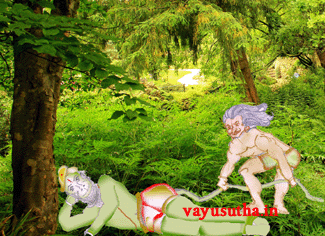 Sriman Narayan, who had taken the avatar as Lord Rama, had left for Vaikuntha after showing us the
importance of governance through dharma. All the characters of Ramayana had left for Vaikuntha, but
Hanuman remained here with us in this world to spread the importance of Ramarajya and dharma. Not only
that, he had seen Sriman Narayan as Lord Krishna in the next yuga, Dwapara Yuga. There is anecdote in
Mahabarata when Pandavas were in exile imposed by Duryodhan, the presence of Hanuman is discribed.
Sriman Narayan, who had taken the avatar as Lord Rama, had left for Vaikuntha after showing us the
importance of governance through dharma. All the characters of Ramayana had left for Vaikuntha, but
Hanuman remained here with us in this world to spread the importance of Ramarajya and dharma. Not only
that, he had seen Sriman Narayan as Lord Krishna in the next yuga, Dwapara Yuga. There is anecdote in
Mahabarata when Pandavas were in exile imposed by Duryodhan, the presence of Hanuman is discribed.
Pandavas, when in exile and roaming about in jungles, Draupadi smelt a divine fragrance. She was so enamoured of the fragrance and she requested Bheema to fetch the flower. Bheema went in search of the flower following the lead given by the fragrance. He found an old-looking monkey covering the path on his way. Bheema condescendingly asked the monkey to make way for him, unaware that the monkey was none other than his brother Hanuman (both are Vayu Amsa). The arrogance in the tone of Bheema prompted Hanuman to tell Bheema to make his way by lift the tail of his. Bheema, tried reluctantly lifting the tail of Hanuman that was blocking his way. But was unable to move the tail of hanuman even after several tries. Then, he realised that the monkey is none other than Lord Hanuman. Bheema apologised for his arrogant behaviour and said had realised that power devoid of arrogance is greater.
On the request of Bheema, Anjuna, and Lord Krishna, it is said that Lord Hanuman during the Kurushetra war was present in the flag post of the chariot of Anjuna driven by Lord Krishna.
Ancient Temples of Indraprashtha
Five shrines in Delhi that are identified with Pandavas by tradition in their Indraprastha. They are Yogamaya temple in Mehrauli, Kalkaji Maa Temple in Kalkaji, Bhairav Temple near Purana-killa (Old fort), Bhairav temple in Kalkaji, BalaHanuman Temple, Connaught Place near Jantar Mandir. The shrines built during more or less same period have idols that are swayambhuhu (self-manifested ones)
Ancient Hanuman Temple
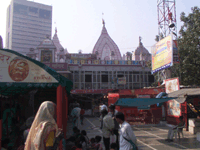 The Hanuman Temple, situated on Baba Kharak Singh Marg, New Delhi, is one of the oldest Hanuman
temples in India, dating back to the era of the Pandavas. The temple is located near Connaught Place
and Jantar Mandir. The idol of this mandir is a Swayambhuhu.
The Hanuman Temple, situated on Baba Kharak Singh Marg, New Delhi, is one of the oldest Hanuman
temples in India, dating back to the era of the Pandavas. The temple is located near Connaught Place
and Jantar Mandir. The idol of this mandir is a Swayambhuhu.
The city of Delhi, the Indraprashtha is part of the history and was the seat of power for many dynasties. There are legendary stories of Hindu resistance by the Rajput King, Prithviraj Chauhan, against repeated Muslim invasions. Several temples built by Tomars and Chauhans were pulled down by the conquering Muslims and the stones of the temple were repurposed mainly in the construction of the Auwwat-ul-Islam mosque at Lal Kot, in the Qutb complex.
The Hanuman temple in Baba Kharak Singh Marg near Connaught Place could withstood Mughals' on-slot of Hindu temples. There is a crescent moon symbol in the vimana, instead of the Aum or Sun symbol above the vimana as in other Hindu shrines. The crescent moon symbol in the vimana is not to be found normally in any Hindu temple, while where sun god, or AUMKARA is given prominence.
The temple of Mahabharata period in the heart of New Delhi, and deity of the temple Sri Hanuman resembles a child, hence Lord is known as Bal Hanuman.
Deity Bal Hanuman
 The deity of Hanuman of this temple is very unique, as the face of the deity resembles a Balak (young
child), hence Bhagawan of this temple is known as Bala Hanuman. The idol in ardha-shile form and is
facing south, and devotee could see only one eye of the Lord. Bhagawan Bala Hanuman is seen carrying
the Gadha in His left hand and His right hand rests over his chest as in prayer. Adorned with flowers
and chentura, one needs to study the form of the murti to observe this.
The deity of Hanuman of this temple is very unique, as the face of the deity resembles a Balak (young
child), hence Bhagawan of this temple is known as Bala Hanuman. The idol in ardha-shile form and is
facing south, and devotee could see only one eye of the Lord. Bhagawan Bala Hanuman is seen carrying
the Gadha in His left hand and His right hand rests over his chest as in prayer. Adorned with flowers
and chentura, one needs to study the form of the murti to observe this.
This Swyambhuhu Hanuman was identified by Maharaj Mangaldas, or Dadaguru as he is known following divine instructions received by him, and established the Swyambhuhu Hanuman.
The temple complex
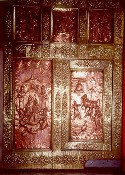 The temple’s main entrance gate, known as Dwar is adorned with embossed artwork done by the skilled
craftsmen is a testimony of the devotion. The importent scenes from the epic of the Ramayana is
depicted in this art form, in the Dwar of centuries old. The temple complex was renovated during late
seventies. On the roof of the main mantap, scenes from Ramayana, as seen by Swami Tulsidas, had been
painted . The paintings that are done so beautifully is a feast to the eyes. Verses of Sundarakand of
Swami Tulsidas's Ramachritha manas engraved in marble stab are seen just below the paintings.
The temple’s main entrance gate, known as Dwar is adorned with embossed artwork done by the skilled
craftsmen is a testimony of the devotion. The importent scenes from the epic of the Ramayana is
depicted in this art form, in the Dwar of centuries old. The temple complex was renovated during late
seventies. On the roof of the main mantap, scenes from Ramayana, as seen by Swami Tulsidas, had been
painted . The paintings that are done so beautifully is a feast to the eyes. Verses of Sundarakand of
Swami Tulsidas's Ramachritha manas engraved in marble stab are seen just below the paintings.
The entire temple complex had been redone and developed by the New Delhi Municipal Council with great care and to serve as a hub for the religious activities. The complex is also renowned for the 'mehandi’ work done on the hands of ladies. Designs are drawn using mehandi paste on the palms of ladies . This art form is popular in Rajastan had come to stay here in Delhi, and this temple complex serves as a node.
Location of the temple: "Pracheen Hanuman Mandir, Connaught Place, NewDelhi"
Experience
When in Inderaprasta (Delhi) next time, visit this ancient temple and have darshan of the Bala roopi Hanuman and be assured of peace of mind.
OTHER INTERESTING TEMPLES
SRI HANUMAN THINKS DIFFERENTLY, THINKS FAST
THINKS AHEAD AND ACTS FOR SURE
Ed [Prior to July 2001]
updates: Sep 2019, Dec 2024