
Temple constructed with the contribution made by devotees
Sri Veera Anjaneya Swami Temple
Thirupathippuliyur, Cuddalore, T Nadu
sri govindarajan, pondicheery

Shri Divya Desam
Great devotees of Lord Vishnu and Acharyas who spread Sri Vaishnavoom are known as Azhvargal in Tamil. They visited many of Lord Vishnu’s temples in the course of their time and sang in praise of the presiding deity of the place. Such sthalas thus visited by Sri Azhvargal are known as Shri Thivia Desam. There are one hundred and eight sthalalas that are frequented by the followers of the Sri Vaishnavoom philosophy. The praise in the name of the Lord (the hymn) by these great saints is known as passuram and is sung today by the devotees with great reverence.
Thiruvaheendrapuram
Thiruvaheendrapuram, which is known for the influence of Lord Anjaneya’s presence, is situated five kilometers west of Cuddalore, the historical coastal city, and is one among the 108 Divya Desams sanctified by the visit of Alwars. The temple of Lord Devanatha is flanked by the inspiring Oushada Giri (herbal mountain), an herbal drop from the hands of speeding Anjaneya to the battlefield of Lanka, and the serpentine holy river Garuda Nadhi, also known as the Ketila River. The importance of the Thiruvaheendrapuram sthala has found a place in many Puranas.
Along the Garuda nadhi- Cuddalore
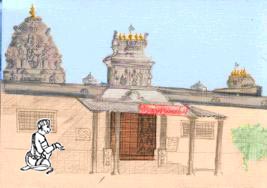 This beautiful Ketila River (Garudanadhi) flows through the historical coastal city of Cuddalore. The
city of Cuddalore is also known by the name Thirupathiripuliyur. The river flows from North to South
at the western end of the city. The place is known as Cuddalore since this river is amalgamating with
the Bay of Bengal near this town; cuddal [kudal] [கூடல்] in Tamil means joining. It is natural that
this city that is near Thiruvahendrapuram also influences of Lord Anjaneya's presence.
This beautiful Ketila River (Garudanadhi) flows through the historical coastal city of Cuddalore. The
city of Cuddalore is also known by the name Thirupathiripuliyur. The river flows from North to South
at the western end of the city. The place is known as Cuddalore since this river is amalgamating with
the Bay of Bengal near this town; cuddal [kudal] [கூடல்] in Tamil means joining. It is natural that
this city that is near Thiruvahendrapuram also influences of Lord Anjaneya's presence.
Treasure found
Around a hundred and twenty years ago, a booking clerk by the name of Sri Srinevasa Iyer was working at the Thirupathiripuliyur railway station. During those days, on both banks of the river, there was thick wild growth of shrubs. One fine day, Sri Srinevasa Iyer, who was a devotee of Lord Sri Rama, dreamt of having seen the Lord and was directed to search for the idol of Lord Anjaneya on the banks of the river Ketila. The search was organised, and the Lord Anjaneya's idol was found on the western bank of the river Ketila. The shrubs around were cleared and the idol was installed in the same place where it was found. The idol was seen by pundits and was named Veera Anjaneya. Sri Srinevasa Iyer constructed a small tenement in that very place for Lord Veera Anjaneya with the contribution made by devotees. It is said he used to collect a quarter of an anna (the then coin—an anna is valued at six paisa of today) from whomever he knew and started building the temple.
The vigraha of Lord Hanuman found on the western bank of the holy river Ketila was installed there itself, and the temple was constructed then.
Temple for Lord Veera Anjaneya
In the meantime, the city started developing, and more citizens came to know of the temple. The Lord Veera Anjaneya temple started drawing large devotees. Devotees started contributing, and the temple was developed in bits and pieces. An undivided family owned the land on which the temple stood. The trust was then formed, and the land measuring about 1.05 acres was purchased in 1982. The temple is measuring eighty-five feet east-west and fifty feet in breadth. As the temple was built in bits and pieces, it was decided to rebuild the temple with more accommodation and at the same time as a compact complex. It was decided, that in order to maintain the sanctity, the location of the original installation of the idol will not be disturbed while reconstruction of the temple is undertaken.
Therefore, work to this end was started in January 1990, and the present temple construction was finished in 1992. A beautiful arch welcoming and indicating the entrance to the temple had been built on the main road near the Ketila River Bridge.
The Vigraha
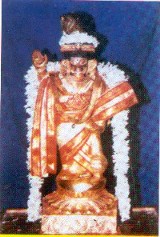 A two-minute walk will bring you to the main temple complex entrance, and the impressive vimana
welcomes you. As you enter from the south into the complex, you will find the main entrance to the
temple on the eastern side. The main idol (moolavar) is seen in ‘ardha shila roopa’
facing the east. Sri Veera Anjaneya Swami of this kshetra is seen walking north with His right
hand in ‘abhaya mudra’ and the left hand resting on his hips. The 'maha kumbabishekam'
was performed on 30th August 1992.
A two-minute walk will bring you to the main temple complex entrance, and the impressive vimana
welcomes you. As you enter from the south into the complex, you will find the main entrance to the
temple on the eastern side. The main idol (moolavar) is seen in ‘ardha shila roopa’
facing the east. Sri Veera Anjaneya Swami of this kshetra is seen walking north with His right
hand in ‘abhaya mudra’ and the left hand resting on his hips. The 'maha kumbabishekam'
was performed on 30th August 1992.
Pujas and Festivals
The puja of this temple is performed as per the 'panchararthra' Agama rules. With the participation of the devotees, the Hanumath Jayanthi is performed every year on the new moon day of the 'Markazi' month of the solar calendar. 'Uthsava moorti’ is seen in a standing posture with a gadha in his left hand, and with his right-hand offers abhaya to his devotees. Every month on the new moon day, the 'uthsava moorti' of Lord Veera Anjaneya is taken in procession around the temple. Sri Rama Navami celebrations are conducted for thirteen days and end with Anjaneya Uthsavam on the following full moon day. Tamil New Year’s Day is celebrated in this temple with the lighting up of one lakh oil lamps known as 'lakshadeepa' with the participation of devotees in many numbers, which is unique to this temple.
Location of the temple: "Sri Veera Anjaneya Swami Temple, Cuddalore"
Experience
A visit to this Lord Veera Anjaneya temple in this coastal city will give us immense pleasure and satisfaction at having seen the Lord who had presented Himself before the devotees and who is a 'patithapavanaa' to bless us with all the rightful things we wish to achieve.
OTHER INTERESTING TEMPLES
SRI HANUMAN THINKS DIFFERENTLY, THINKS FAST
THINKS AHEAD AND ACTS FOR SURE
Ed [ed 02.01.2003]
the author is wkg with Puducherry Police
Updates: Jan
2025]