

Sajjangad
Sajjangad Hill is located 10 kilometers from Satara city in Maharashtra. This hill is at an elevation of 3000 feet above sea level. When seen from above, it has a conch-shaped appearance. Shambhu Mahadev is a sub-range of Sahyadri, starting from Pratapgad on the eastern side. This range is divided into three parts, and Sajjangad is situated on one of these subranges. This hill is very sacred, and in ancient times, Saint Ashwalayan lived here.
Fort in Sajjangad
There is a fort on the top of this hill, hence known as Sajjangad, which translates to "Fort of Good People." Since the Saint Ashwalayan resided on this hill, the fort is also known as Ashwalayan Gad or Ashwalgad. The village at the base of the fort is known as Parali; therefore, this fort was also known as Parali Fort.
Historical records suggest that this fort was built during the reign of the Bahamani rulers between 1358 and 1375. Later, it went into the hands of Adilshah, who seized a portion of the Bahamani state. Notably, in 1632, Phajal Khan was documented as the custodian of the fort. According to some, the fort was originally constructed in the 11th century under the reign of King Bhoj of the Shilahar dynasty.
On 2nd April 1673, this fort was conquered by Shivaji Maharaj from Adilshah. Then, after, on 21 April 1700, Fatehullah Khan laid siege to Sajjangad. On 6 June 1700, Sajjangad fell under the control of the Mughals and was renamed as Navrous Tara. However, in 1709, the Marathas again conquered the fort. It remained in Maratha hands until the demise of the Maratha Empire by the British in 1818, and the fort fell into the hands of the British.
Samarth Ramdas Swami and Sajjangad
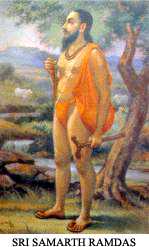 We invite you to read the brief biography of Sri Samarth Ramdas on our website. Samarth Ramdas Swami was the founder of a significant spiritual movement known as the 'Ramdasi Sampradaya.' The same movement/revolution took the structure of organization when Samarth Ramdas Swami established his monastery (mutt) at Chafal, Maharashtra, in 1648 AD.
While this event holds religious significance, it also has historical importance. Soon after the establishment of the monastery (mutt) at Chafal, the illustrious King Chhatrapati Shivaji Maharaj became a disciple of Shri Samarth Ramdas Swami by accepting him as his Guru in August 1649 AD.
After capturing the fort of Sajjangad in 1673, Shivaji Maharaj invited Samarth Ramdas to move to Sajjangad and requested him to settle down at Sajjangad. Saint Samarth Ramdas then moved there from Chaphal, making Sajjangad his final abode in 1676. The fort till time known as Parali fort, was named Sajjangad [Fort of Good People]. Samarth Ramdas spent the latter part of his life here until his passing in 1682.
Sri Maruti and Sajjangad
According to the earliest historical records, the region was under the rule of the Bahamani rulers, and the fort was built between 1358 and 1375 by them. Later, it went into the hands of Adilshah, who seized a portion of the Bahamani state. This hilltop remained under external control until Shivaji Maharaj successfully conquered Adilshah in 1673. Soon after, Samarth Ramdas came to this kshetra in 1676.
A temple dedicated to Sri Maruti was in existence here even before the area came under the control of the Marathas in 1673. The temple is known as Pethili Maruti Mandir. The term "peth" in Marathi refers to a specific market area or locality within a city. It is a tradition to have a temple at the center of the city, and to develop the city with the temple as the nucleus. This practice has been in existence for a long time in Bharat. In this kshetra, the Sri Maruti temple became the nucleus around which Sajjangad was established.
The original structure of the Maruti temple was likely modest then, and has been developed over time to the present structure. Many rulers, public, and devotees must have contributed towards this development.
A temple dedicated to Sri Maruti was in existence here even before the area came under the control of the Marathas in 1673. The temple is known as Pethili Maruti Mandir. The term "peth" in Marathi refers to a specific market area or locality within a city. It is a tradition to have a temple at the center of the city, and to develop the city with the temple as the nucleus.
Peth Maruti temple
Peth Maruti Temple is situated on the southern bank of the Sonale Lake, which supplies drinking water to the entire path. The water in this lake is used for drinking. There is a sacred place dedicated to Sati Asara in the lake. These seven goddesses are associated with rivers, wells, and other water sources and are believed to be benevolent.
 The Maruti Temple in Peth is in front of Shridharkuti. The temple is very modest, comprising a hall that leads to the Garbhagriham, where the presiding deity, Sri Peth Maruti, is enshrined, facing south.
Worship of Sri Peth Maruti is integral to the various ceremonies conducted at Sajjangad. When Maharudra Anushtana to Samarth Samadhi is observed from Shravana Shuddha Pratipada to Amavasya, all fifteen days of pooja and Rudranushtana are performed in this temple.
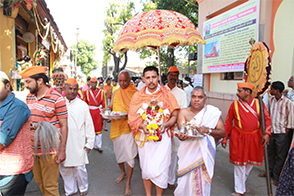
During the Dasanavami festival, a grand procession named ‘Chhabina’ takes place, from Samarth Samadhi Temple to Pethetil Maruti Temple. The idol of Maruti is carried on a palanquin, flanked by ceremonial fans (Camaras), and accompanied by triumphal flags, banners, torches, and the instruments playing mangala swaram, alongside the chanting of Vedic mantras.
 During Hanuman Jayanti on the full moon day of Chaitra Month, bhajans at the birth time of Lord Hanuman, shodashopchar mahapooja of Lord Hanuman are performed.
Pethetil Maruti
The Sri Maruti idol is of the embossed type on a granite slab placed under a decorated mandapa.
Maruti is in the standing posture, looking graceful. Both His lotus feet adorn thandai. His left hand is resting on the left thigh, holding the stem of the sowgandika flower. The sacred yagnopaveetam is seen across his chest. There is a mala close to His neck with a pendant, and the second mala dangles up to His navel. Lord is wearing a dothi in katcham style. The long tail of the Lord arches gracefully over His head. His stretched right hand is showing ‘abhaya mudra’. The ‘uthriyam’ is seen over His shoulder. His bright face is looking straight. He is wearing kundalam in His long ears. His kesam is neatly combed and braided, a portion of which is seen near the left shoulder. His eyes are glowing with mercy, blessing the devotee. The compassion thus showered can be felt in His presence by seeing His eyes.
Location of the temple: "Sri Pethetil Maruti Temple, Sajjangad"
Experience
Visit this kshetra where the Lord revealed Himself to bless His devotees, and have darshan, and rebuild the confidence to achieve the best of life righteously.
SRI HANUMAN THINKS DIFFERENTLY, THINKS FAST
THINKS AHEAD AND ACTS FOR SURE
Ed [January 2026]


