
Temple ordered to be built by Engineer in charge by the Lord
Sri Kallukuzi Anjaneya Swami Temple, Trichy, Tamil Nadu
dr. sri jaya shanker, new delhi

Trichirapallai
When you think of undertaking a pilgrimage to holy temples in South India, the first thing that will come to your mind is the Thanjavur District of Tamil Nadu. There are many pleasant old temples around this district; one will have to wonder whether the time is sufficient to see and enjoy them all. Adjacent to this district is the Trichirapallai district, with Trichirapallai as the district headquarters. Trichirapallai is more popularly known as Trichy. When any devotee hears the name Trichy, he will remember the place, which is also famous for “Malai Kotai Uchi Pillair Kovil” and also Srirangam and Tiruannaikaval, two suburban towns famous for Sri Ranganatha Swami and Sri Jambunatha Swami.
 Nayaks were the founders of Trichy City; it was one of the main centers around which
the wars of the Carnatic were fought in the 18th century during the British-French
struggle for supremacy in India.
Nayaks were the founders of Trichy City; it was one of the main centers around which
the wars of the Carnatic were fought in the 18th century during the British-French
struggle for supremacy in India.
Trichy is built with Malai Kotai (Fort on the mountain) as the center of the town. From any corner of the town, you can see this rock, which soars 83 meters upwards. Halfway up the mountain, there is a beautifully built temple. The temple is the abode of the “Thayumanavar,” a form of Lord Siva who had taken the role of the mother to attend to the delivery of his devotee. Since Lord Siva had performed the duty of a mother, here He is called “Thayumanavar,” meaning ‘who is also the mother.’ It is said that Lord Brahma, Vibishana, and Hanuman the Anjaneya had worshipped Lord Thayumanavar.
Trichy Railway Junction Anjaneyar Temple
When under British rule, there was a lot of developmental activity, like the building of new railway lines for commercial reasons, etc. In one of these, the Southern India Railway Co. had developed Trichy as one of the main junctions for connecting the entire South with Madras, the present Chennai. The choice for building the junction was narrowed down to the place adjacent to the small, beautiful old temple of Anjaneya. The small, beautiful temple for Anjaneya near the then-proposed Trichy railway junction was so old that nobody knows how old it was. The construction works for the lying up of rails were started without disturbing the then-existing Anjaneya temple. When the Trichy junction was initially completed, it was found that the temple of Anjaneya was at the eastern end of the second platform of the junction.
Importance of Trichy Railway Junction
 Two routes that connect Trichy with Chennai. One is known as the main line running
through Thanjavur, and the other is known as the cord line running via Arriyalur.
The Trichy was made one of the main junctions of the South. The Thanjavur, the
granary of the entire South was to be well connected by train if the food grains
were to be moved easily out of Thanjavur District. The main granary of the entire
Thanjavur District was Saliamangalam near Thanjavur. People who were so selling the
granary would either have to move their rice to Salimangalam for the local market or
to Nagapattanam the coastal town, if they wanted to export rice to Burma (Rangoon)
or Malaysia (Pinang). The railway company saw the potential commercial aspect of
this and wanted to build a new line between Trichy and Nagapattanam.
Two routes that connect Trichy with Chennai. One is known as the main line running
through Thanjavur, and the other is known as the cord line running via Arriyalur.
The Trichy was made one of the main junctions of the South. The Thanjavur, the
granary of the entire South was to be well connected by train if the food grains
were to be moved easily out of Thanjavur District. The main granary of the entire
Thanjavur District was Saliamangalam near Thanjavur. People who were so selling the
granary would either have to move their rice to Salimangalam for the local market or
to Nagapattanam the coastal town, if they wanted to export rice to Burma (Rangoon)
or Malaysia (Pinang). The railway company saw the potential commercial aspect of
this and wanted to build a new line between Trichy and Nagapattanam.
Expansion of Railway Junction
In the year 1928, the project for expanding the Trichy junction, for the laying of new rail routes, and for the construction of new platforms was undertaken. It was then felt that without removing the Anjaneya temple from the second platform, the expansion was not possible. The engineer in charge of the construction had ordered the demolition of the Anjaneya temple in the eastern end of the second platform. The laborers were employed, and the work for demolition was undertaken, but the labourers found it hard to do the job. They were not able to progress in the job.
The engineer in charge of the construction had ordered the demolition of the Anjaneya temple at the eastern end of the second platform. The laborers were employed, and the work for demolition was undertaken, but the laborers found it hard to do the job. They were not able to progress in the job.
Anjaneya' move
That very same night the railway agent (presently known as the station superintendent) had a dream as if two rail engines were derailed at the junction. The next morning, to the astonishment of the engineer in charge and the railway agent, they saw that two engines that had derailed. It was then decided that the temple for Anjaneya would be rebuilt in an alternative site near the Trichy Junction itself. An amount of Rs.800/- was also allotted from the Railway Co. towards the cost of construction. Once this decision was taken, then the removal of the statue from the original place became easy, and the idol was re-established (“punar pradeshta”) in the new temple site known as Kallukuzi, the present site where you find the temple.
Present Anjaneya Temple
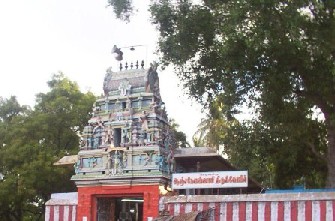
The Kalukuzai Anjaneya temple is now very near the Trichy railway junction. The temple is even now very simple looking and in a calm, serene atmosphere. The east-facing three-tier Rajagopuram welcomes you from a distance. One can see the main deity of Anjaneya from the entrance itself. As you enter the temple, you will step into the big hall that adores many paintings of the Lord depicting the forms He had taken in different kshetras.
Kalukuzai Anjaneya Swamy
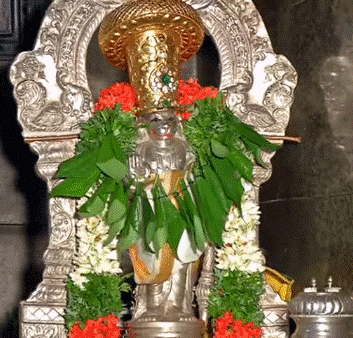
From the hall itself, the devotees can have darshan of the Lord Anjaneya, who is in the form of ‘ardhachitra shila.’ Lord's right hand is shown giving the ‘abaya,’ and on His left hand he is holding the ‘Meru.’ While the deity is facing east, Anjaneya is seen facing north, indicating the situation where the Lord was returning the ‘Meru’ to its original position in the Himalayas after having revived the breath of Laxmana in the Lanka war field.
Devotees who visit this temple have a lot of incidents to tell about how Lord Anjaneya Swami of this kshetra had helped them in solving their woes; while narrating, we could feel their reverence for the Lord.
Location of the temple: "Kallukuzhi Sri Anjaneya Swami Temple, Trichy"
Experience
The Lord, who had brought the Laxmana back to us and returned the ‘Meru’ to its place, is awaiting in this kshetra to fulfill the wishes of His devotees as He is abya varadhan.
OTHER INTERESTING TEMPLES
SRI HANUMAN THINKS DIFFERENTLY, THINKS FAST
THINKS AHEAD AND ACTS FOR SURE
Ed [ed.12.10.02]
Updates: [Jan 2025]
Contact No.
08883566294